
LEX - An ongoing redesign of a legal practice management system
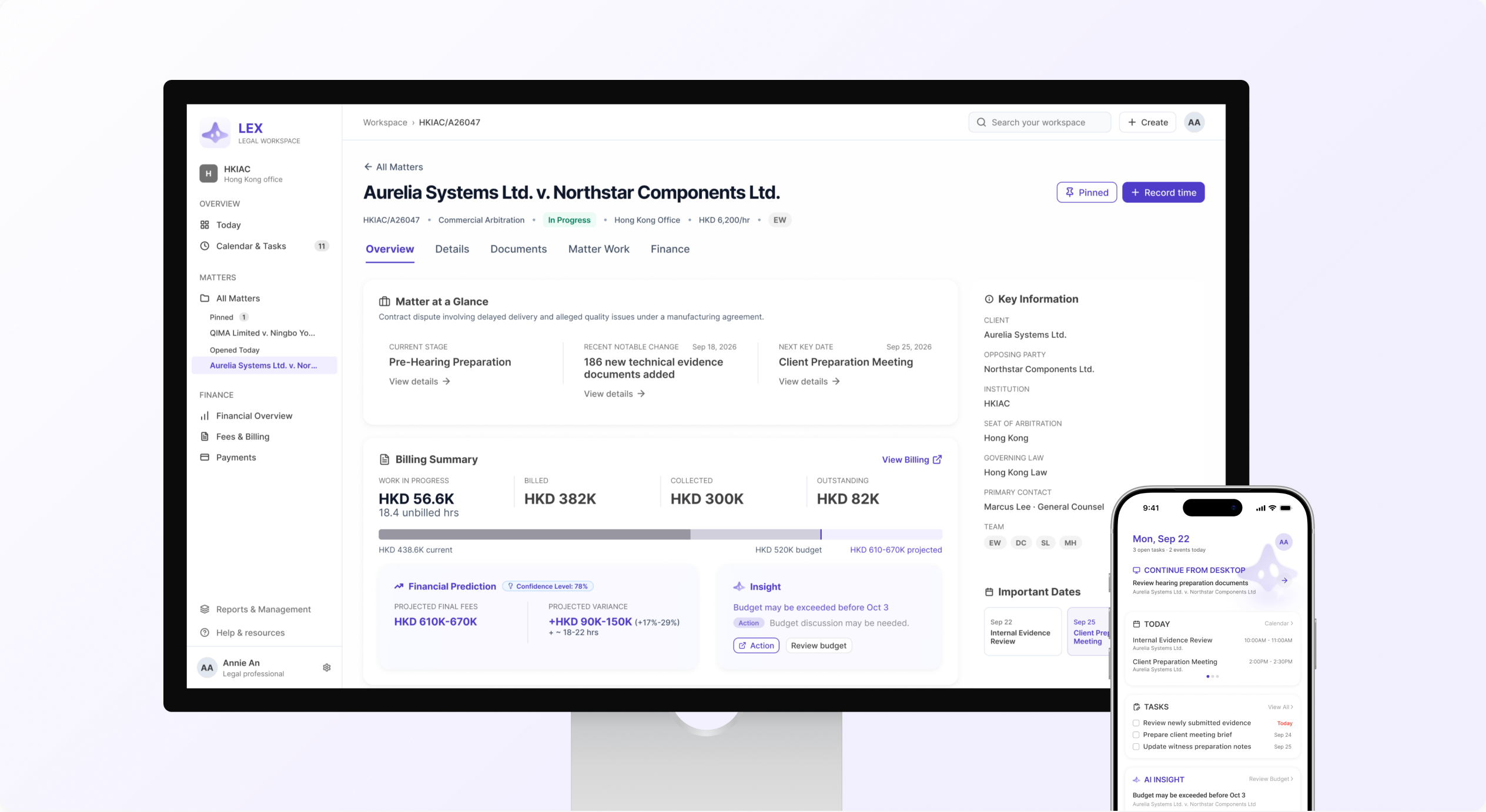
Developed in collaboration with a Hong Kong law firm, LEX redesigns an existing practice management system used by lawyers in their day-to-day work. Building on existing operational workflows and financial data, the project explores how predictive insights and AI-assisted intelligence can support resource planning, financial decision-making, and everyday legal workflows.
- B2B SaaS
- AI-Assisted Data-Driven UX
- Legal Tech
MY CONTRIBUTION
Product and UX/UI design for LEX’s desktop and mobile experiences, including information architecture, data visualization, AI-assisted workflows, and interactive prototyping.
TOOLS USED
Design & Prototyping Figma · Codex
The Existing System
The existing legal ops system was first mapped to understand the current workflow.
A legal Matter moves from case setup and planning to execution, with time recorded throughout the process and ultimately feeding into billing and financial tracking.
LEX already supports much of this workflow and captures a large amount of operational and financial data. The current system moves from global tools and open workspaces into Matter-specific navigation, where case information, ongoing work, and financial records are managed.
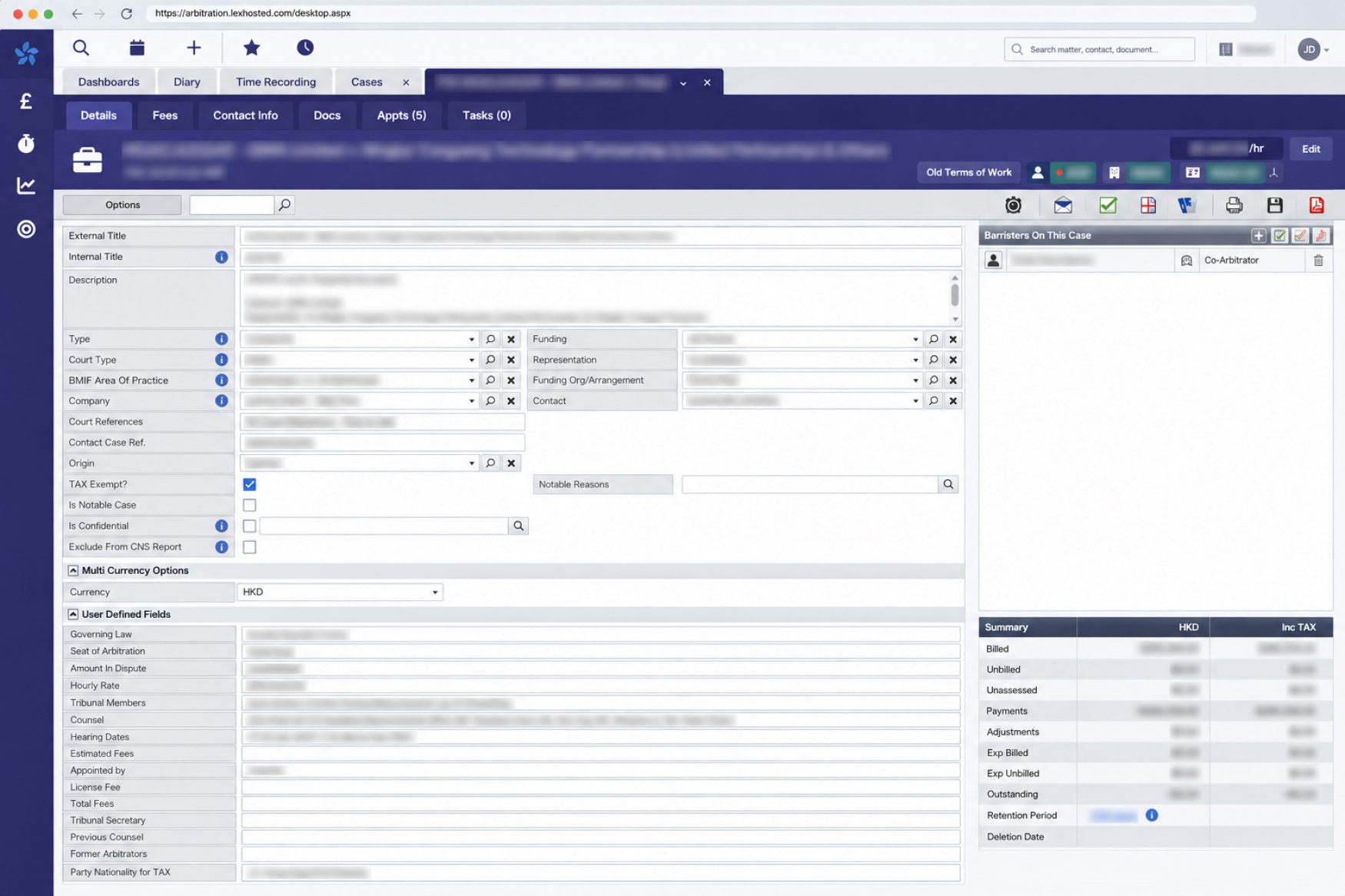


While LEX already supports the core workflow, the existing experience revealed redesign opportunities across navigation, information hierarchy, and how related information is organized and surfaced throughout the system.
Understanding the existing experience established a baseline for the redesign. Next, we looked at what the client needed LEX to support moving forward.
Client Need
The client wanted LEX to help them better anticipate the financial outcomes of ongoing matters and make more informed decisions about workload and resource allocation.
This expanded the redesign question beyond how the existing system works today to how LEX could better support the decisions lawyers make throughout a Matter.
Competitive Analysis
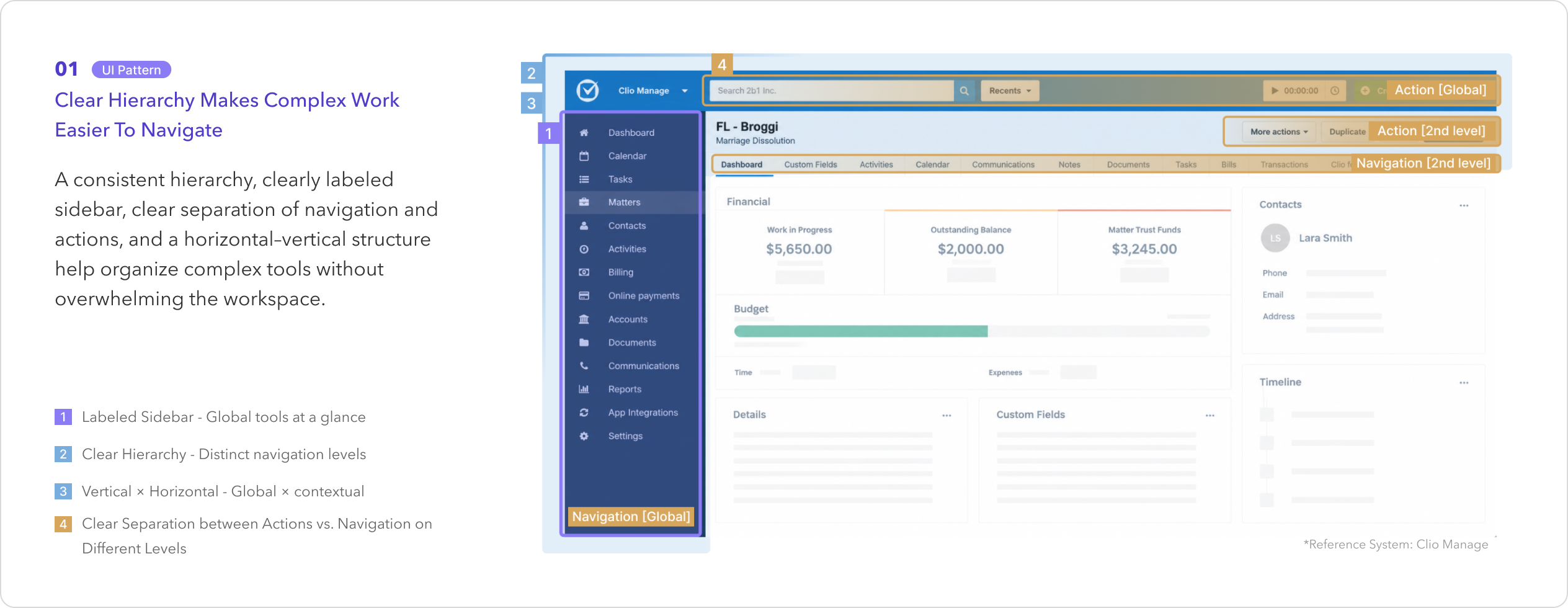
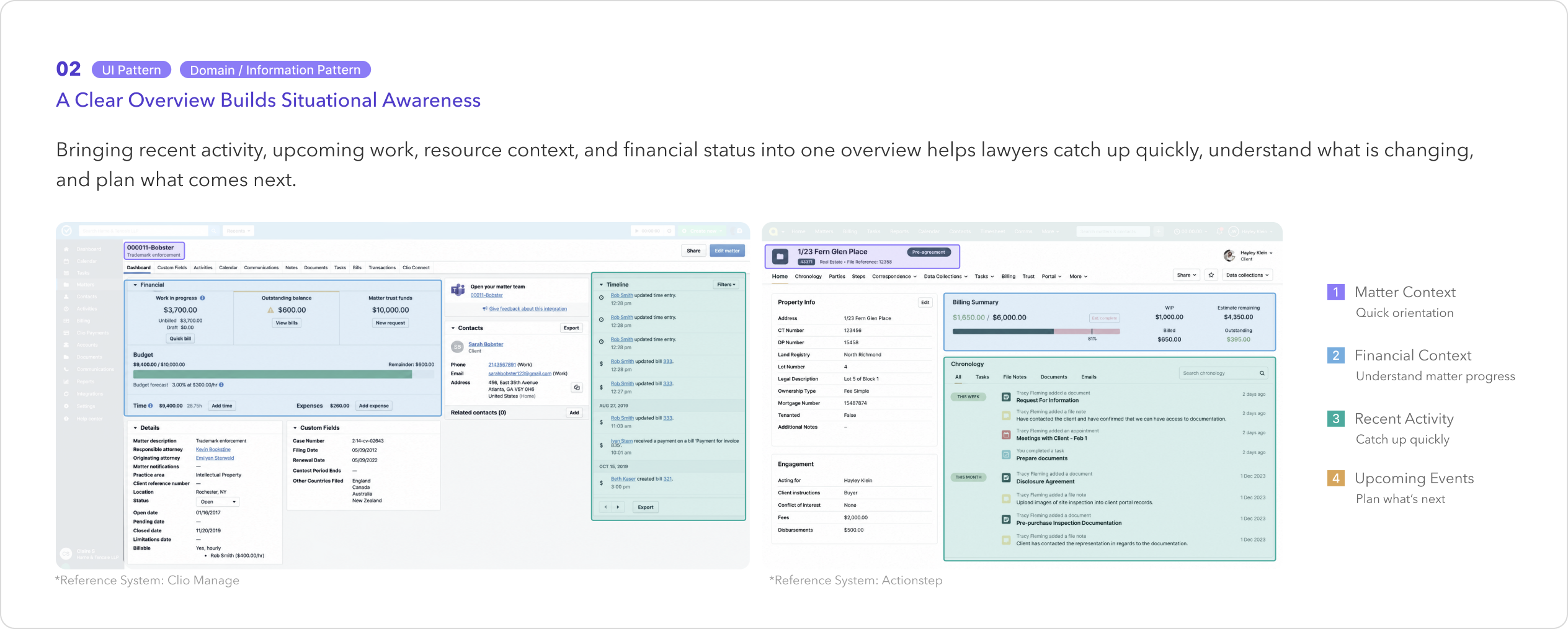
With this client need in mind, I reviewed other legal practice management systems to understand how they structure matter workflows, contextual information, and financial data to support day-to-day legal work and decision-making.
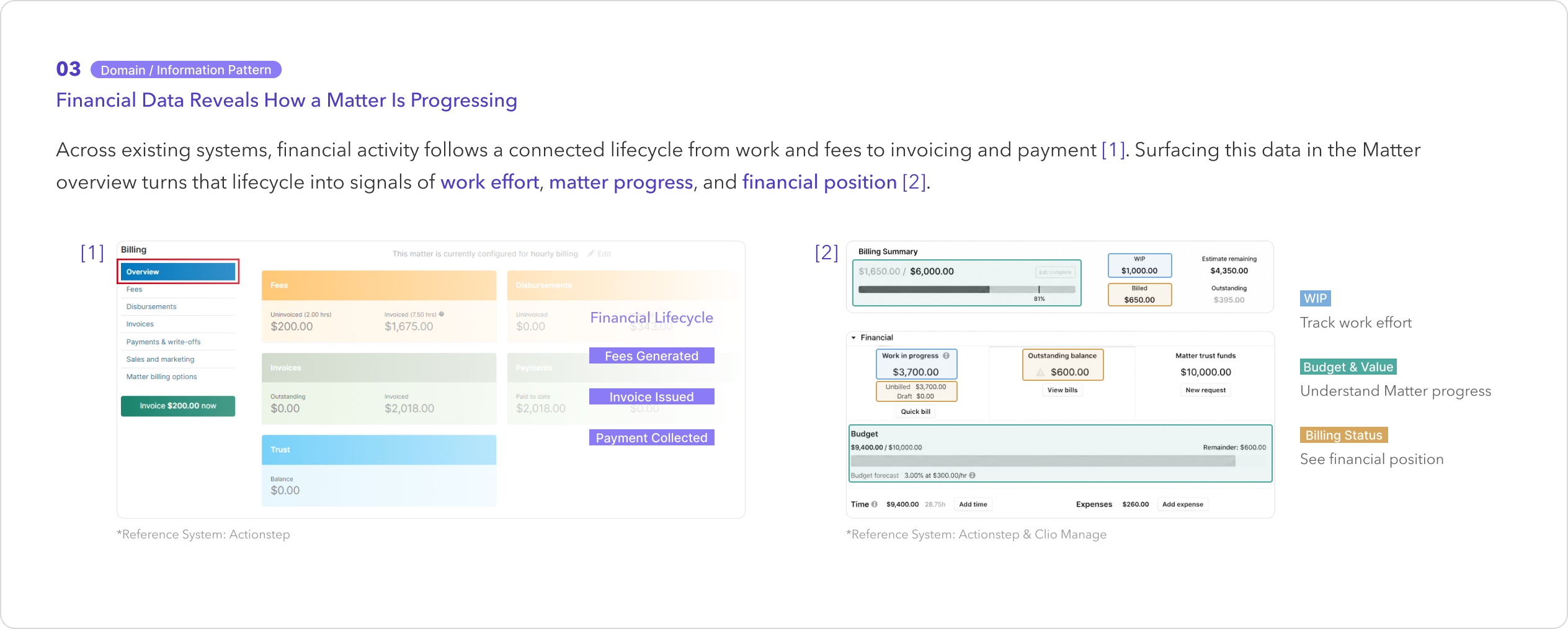
What Existing Systems Already Do Well
Existing systems already provide a strong foundation for understanding and managing ongoing Matters. Clear navigation organizes complex workflows, matter overviews help lawyers quickly rebuild context, and connected financial data makes work effort, progress, and financial position visible.
Some systems also introduce forward-looking signals, but these remain limited and are not yet systematically connected to broader matter decisions.
Shared Opportunity
Every hour spent on a Matter has a cost and billable value. This means changes in work, time, and staffing directly affect the Matter’s financial outcome.
For lawyers and firm management, understanding this relationship is essential for planning the work, allocating people, and managing the budget.
The opportunity is to use this existing data not only to understand what is happening now, but to anticipate what may happen next.
Project Goal
Long-Term Goal
Help the client better anticipate financial outcomes and make more informed resource allocation decisions, making where a matter is heading more visible and actionable.
Current Phase
Translate this direction into a high-fidelity concept workflow, giving the client a tangible preview of the proposed system and key dashboard experiences for alignment before full design and development.
From Current workflow to intelligence-augmented workflow
Current Workflow & Decision Gaps
I mapped how a Matter currently moves through LEX to understand where key financial and resource decisions happen — and where decision gaps emerge.
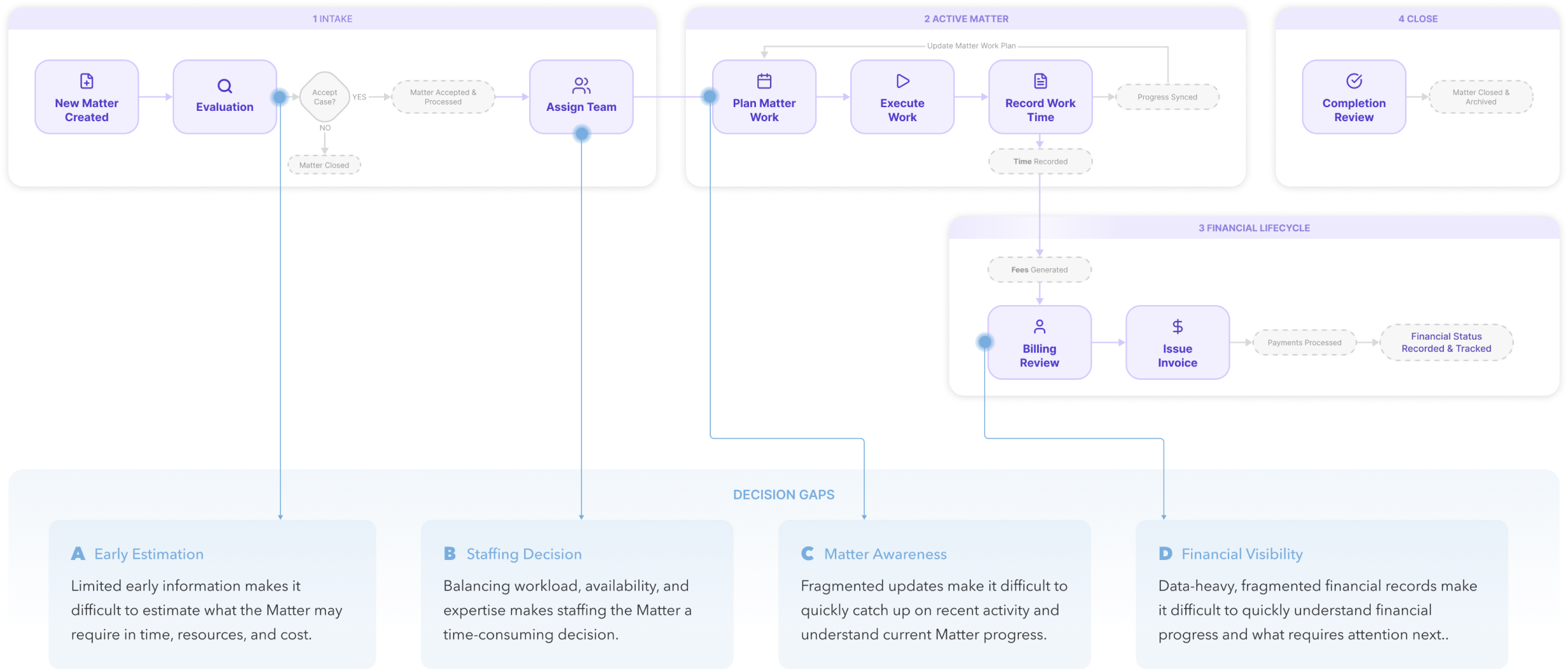
Introducing the intelligence layerAI
These decision gaps pointed to an opportunity to use the data LEX already captures more proactively.
We explored an Intelligence Layer that interprets existing Matter data, surfaces important changes, and anticipates likely outcomes to support decisions throughout the Matter lifecycle.
Intelligence-Augmented WorkflowAI
We mapped the Intelligence Layer onto the existing workflow by introducing capabilities at key decision points across the Matter lifecycle. The yellow callouts represent the AI-enabled features explored in this prototype.
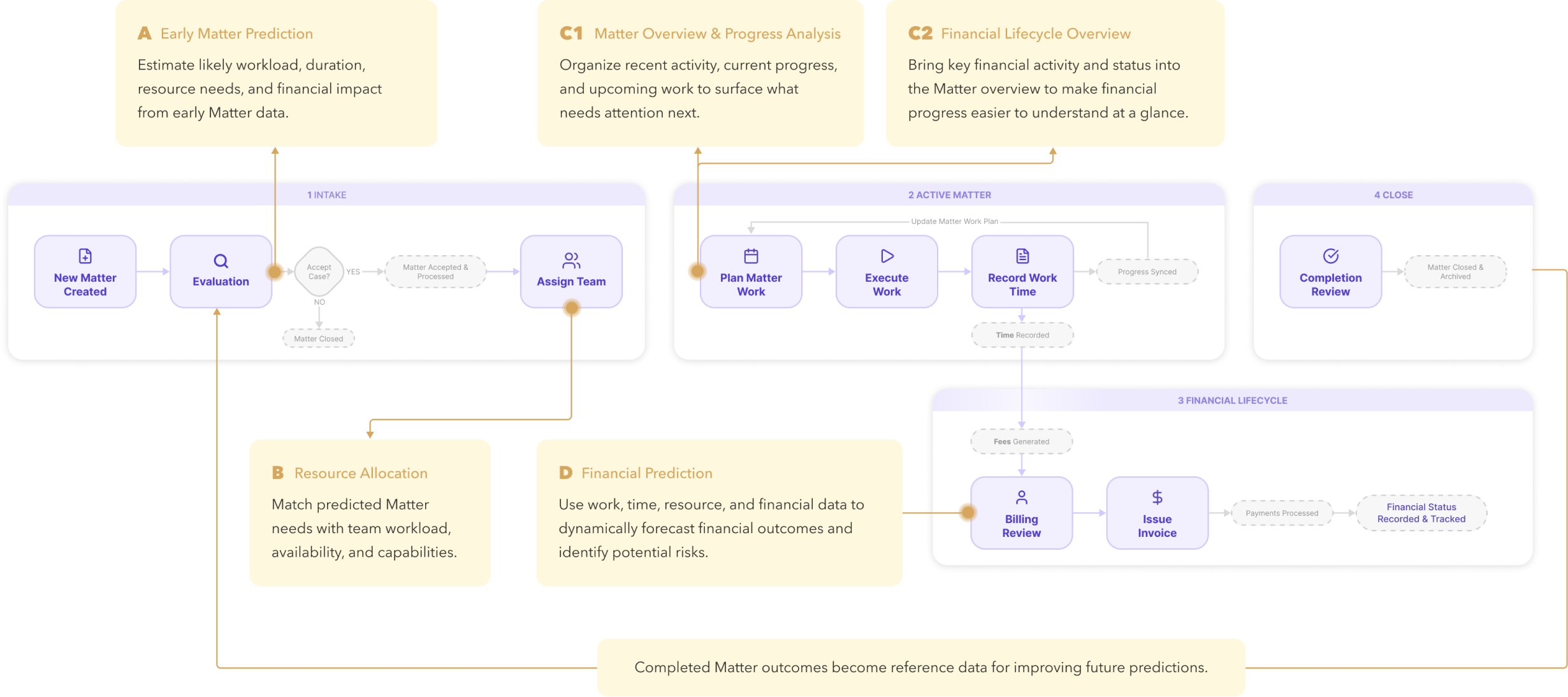
Across the workflow, the Intelligence Layer turns existing Matter data into more proactive support — helping teams understand what needs attention now and anticipate what may happen next.
Among these capabilities, prediction became a key focus because it directly connects the client’s two priorities: financial outcomes and resource allocation.
Intelligence Layer — Prediction LoopAI
Rather than treating prediction as a one-time estimate, we explored it as a continuous loop — updating as the matter evolves and new operational and financial data becomes available.

This same prediction logic can support decisions at three levels:
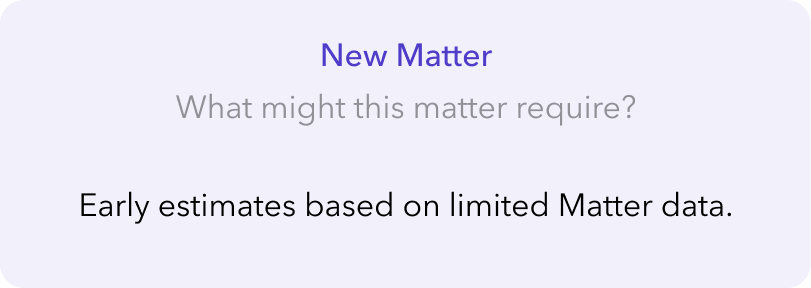

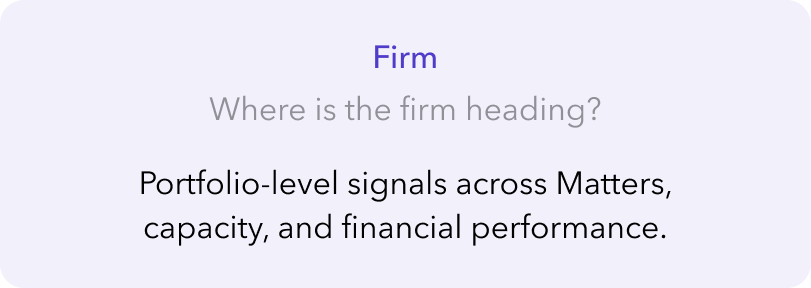
For the current prototype, we focused on the Active Matter level, where LEX’s existing operational and financial data provides the strongest foundationfor more informed predictions.
This gave us a focused starting point to explore how intelligence could enter the existing Matter Overview and translate the broader concept into a tangible experience for early client alignment.
Bringing Intelligence into the Matter OverviewAI
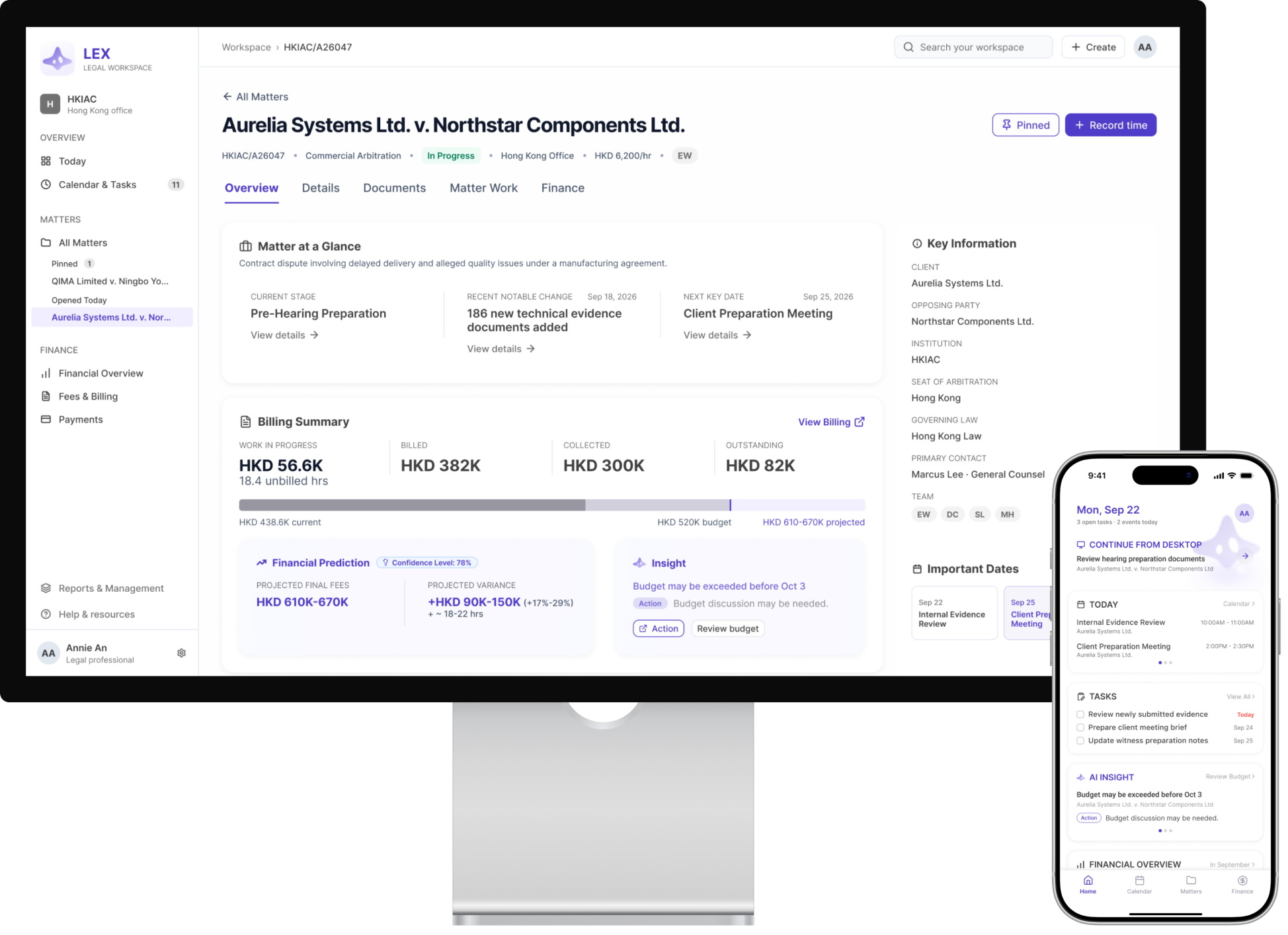
I integrated active matter predictions into the matter overview, placing forward-looking intelligence alongside the operational and financial context lawyers already use to understand a Matter.
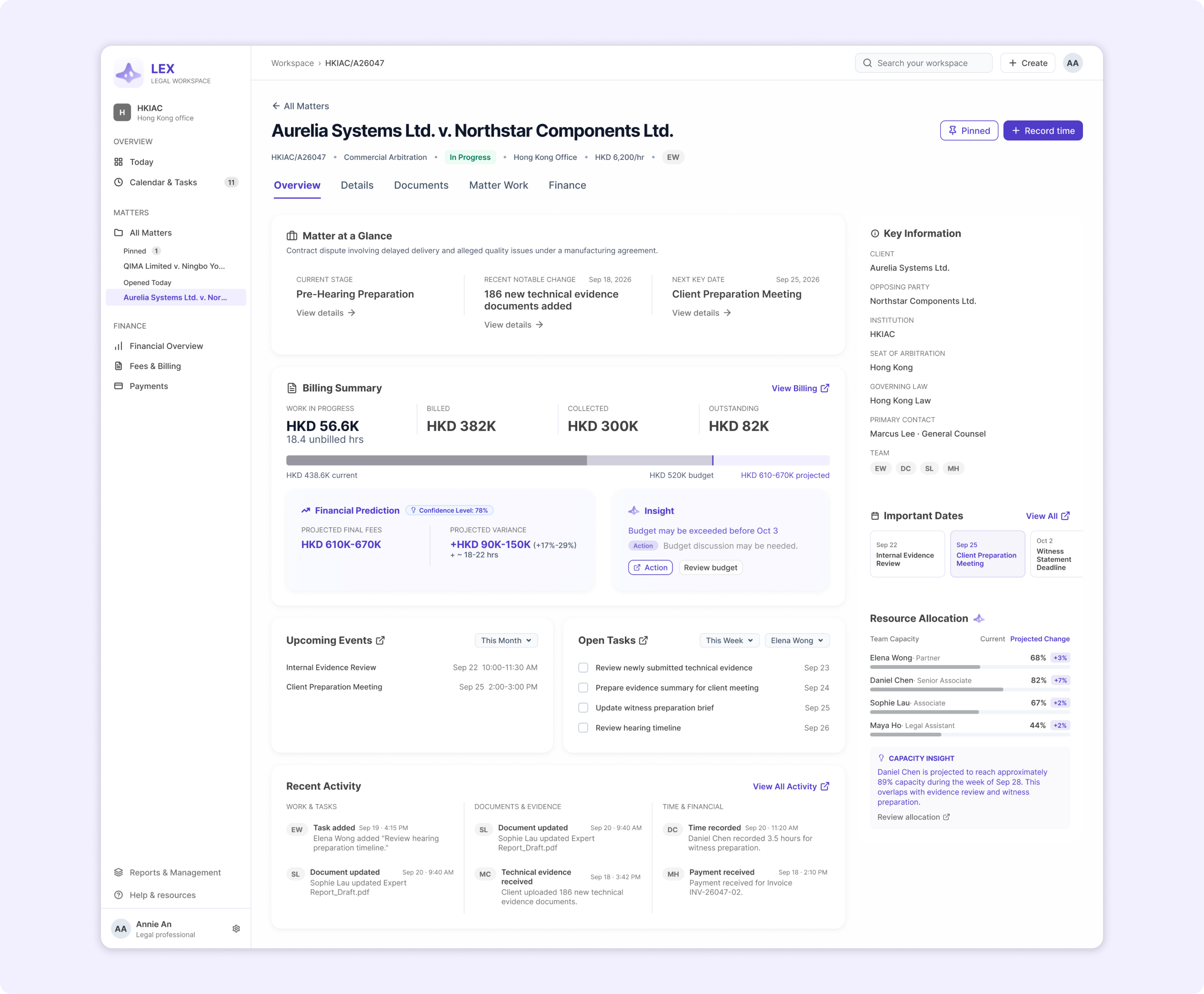
01 Financial Prediction
Provides an overview of where the matter is financially heading. The forecast updates as work, time, resources, and financial data change, surfacing projected outcomes, meaningful variance, and issues that may require attention.
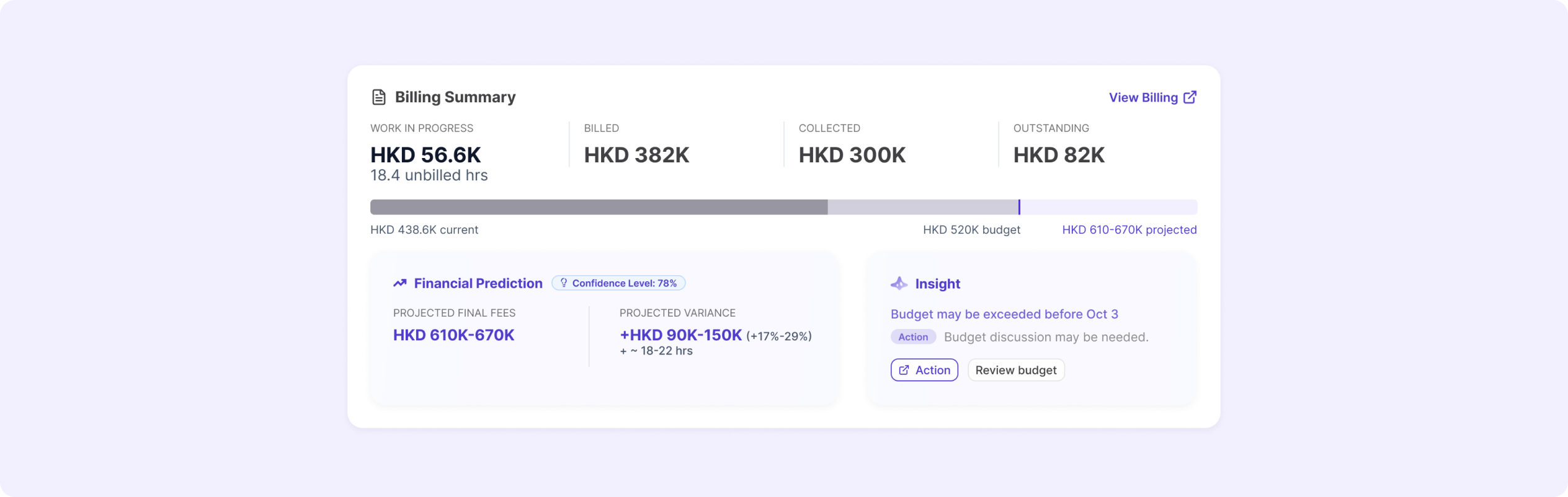
02 Resource Allocation
Shows how projected matter needs may affect team capacity. Predicted workload is connected with team availability and capabilities, helping surface potential capacity issues before they affect the Matter.

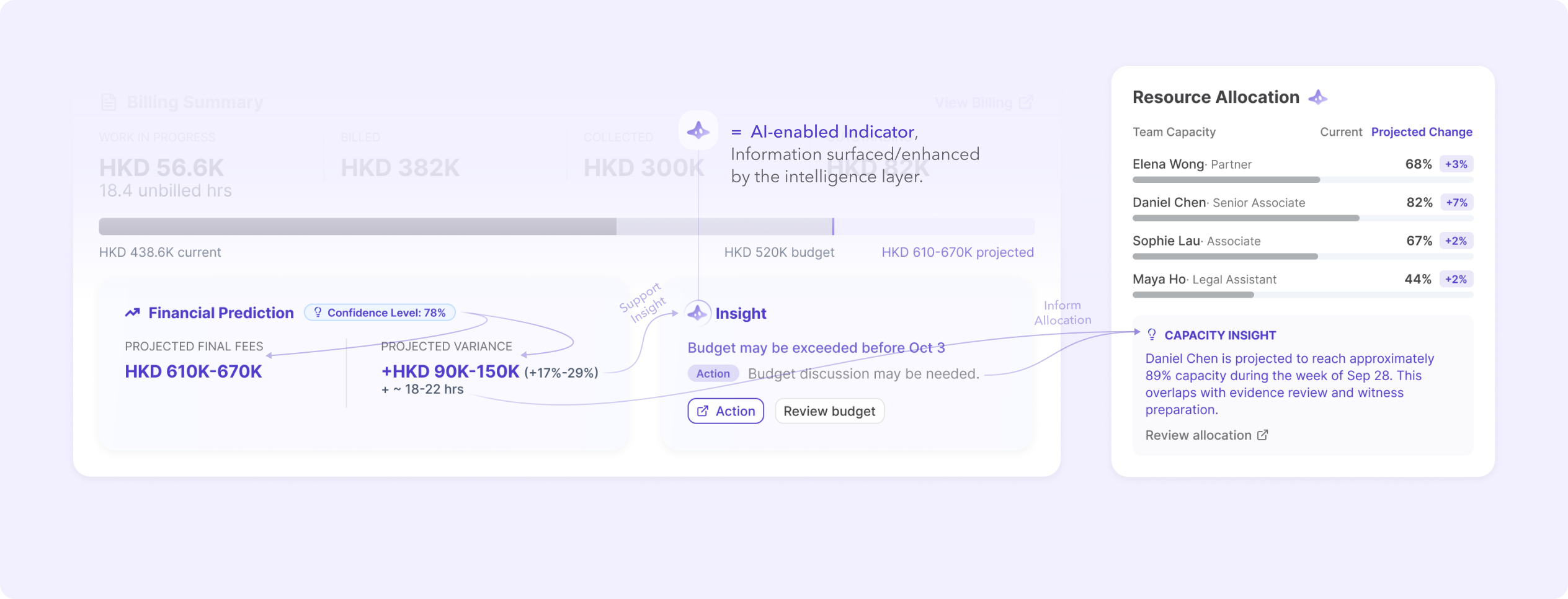
03 Prediction TransparencyAI
Makes AI-generated insights easier to identify and interpret. Clear AI labels, confidence levels, and supporting changes provide context around each prediction, helping users understand what is being projected and what is driving it.
Mobile as an Add-onAI
Rather than replicating the full desktop experience, mobile extends the workflow beyond the desk — providing quick context, continuity, and lightweight actions when lawyers are on the go.
Context 01: Review & Act on the GoAI
A widget-based Today screen brings schedules, tasks, matter updates, financial signals, and AI insights into one glance, while supporting quick follow-up and deeper review when needed.
*a. ‘Continue from Desktop’: Pick up recent desktop work directly on mobile, preserving context across devices.
*b. ‘Customizable Widgets’: Reorder and prioritize widgets based on what matters most — from tasks and Matter updates to financial signals and AI insights.

*c. ‘Document Review on the Go’: For deeper work, the expanded mobile view supports document reading and review, with AI available to summarize content, surface key information, and support lightweight follow-up actions.
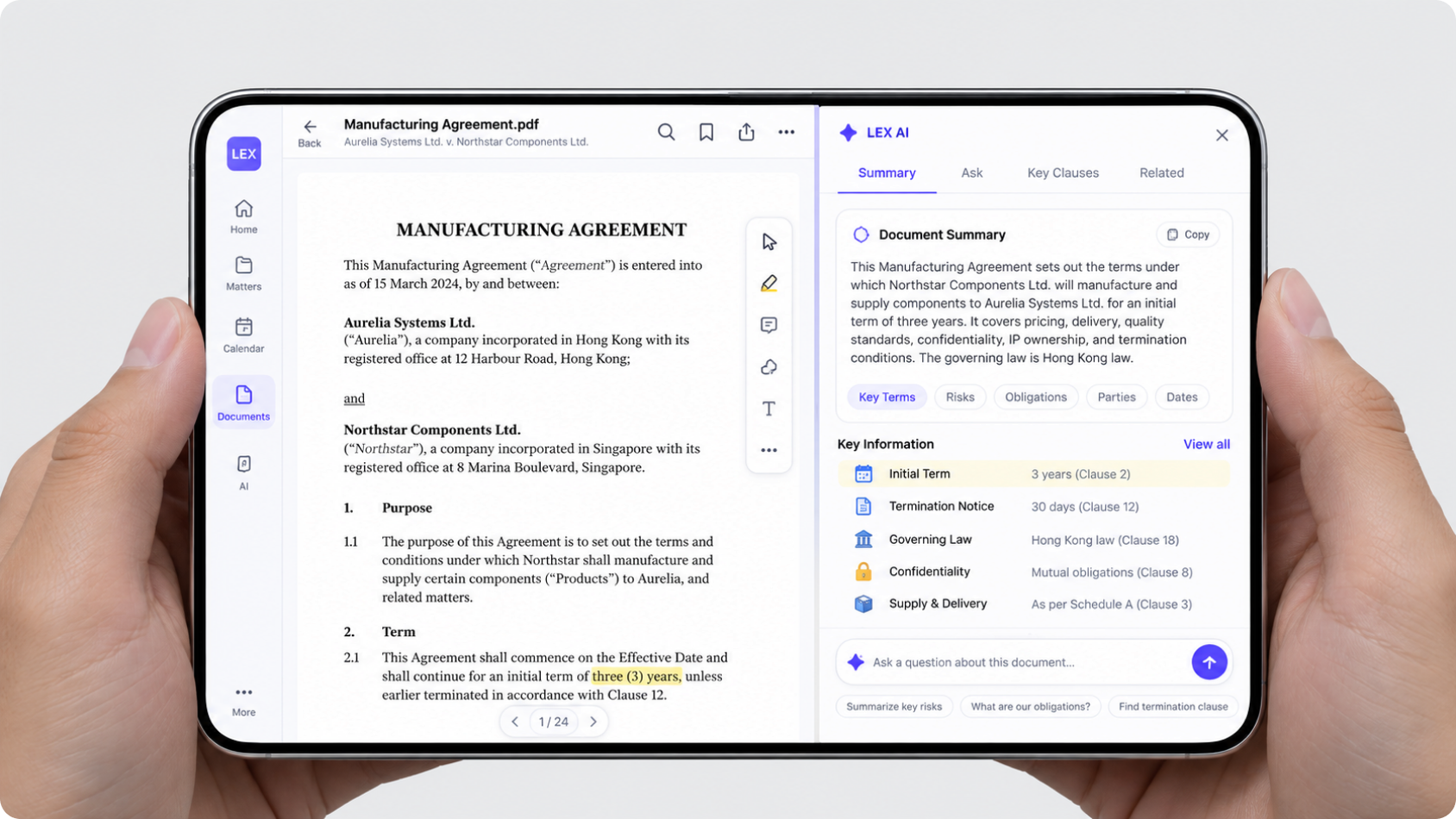 *c
Context 02: Work Across Two Screens
Mobile can also work alongside desktop as a companion screen, keeping supporting context—such as Matter details, schedules, AI insights, or key dates—accessible while deeper Matter work remains on the primary screen.
Prototype for Client Alignment & What Comes Next
This prototype is intentionally not the final product. It makes the proposed Intelligence Layer tangible, giving the team and client a shared experience to align on the direction and validate how predictive capabilities could fit into the existing Matter workflow.
Validation direction includes:
- Workflow - Does the proposed experience fit how lawyers actually manage an active Matter?
- Prediction - Which forecast data are useful enough to support real financial and resource decisions?
- Trust - What context, confidence, and explanation do lawyers need before acting on AI-generated insights?
- Assistance & Efficiency - Where do lawyers actually want predictive assistance, and what kind of support would meaningfully save them time?
The next step is to validate these assumptions with the client, refine the prediction model around available Matter data, and use those findings to define the next iteration of LEX.