

01. From Using AI to Working Alongside It
I started using AI to support my design process, from brainstorming and visual exploration to research and prototyping. But after experimenting with different models and integrating them into my workflow, I began noticing something more significant: AI wasn't just helping me work faster. It was becoming capable of performing parts of the work itself. With ongoing layoffs, automation, and growing discussions around token costs, I've started questioning what it means to be a designer in an industry where the tools we use are also beginning to compete with us.
Rather than trying to produce more designs in less time, I've become interested in how I can better organize the tools themselves. If AI can handle parts of the design process, which tasks should I delegate, which decisions should remain mine, and how can I achieve better results without constantly increasing costs? This led me to think of AI models not just as tools I use, but as building blocks I can select, connect, and design around.
02. Open vs. Closed: Choosing My Building Blocks
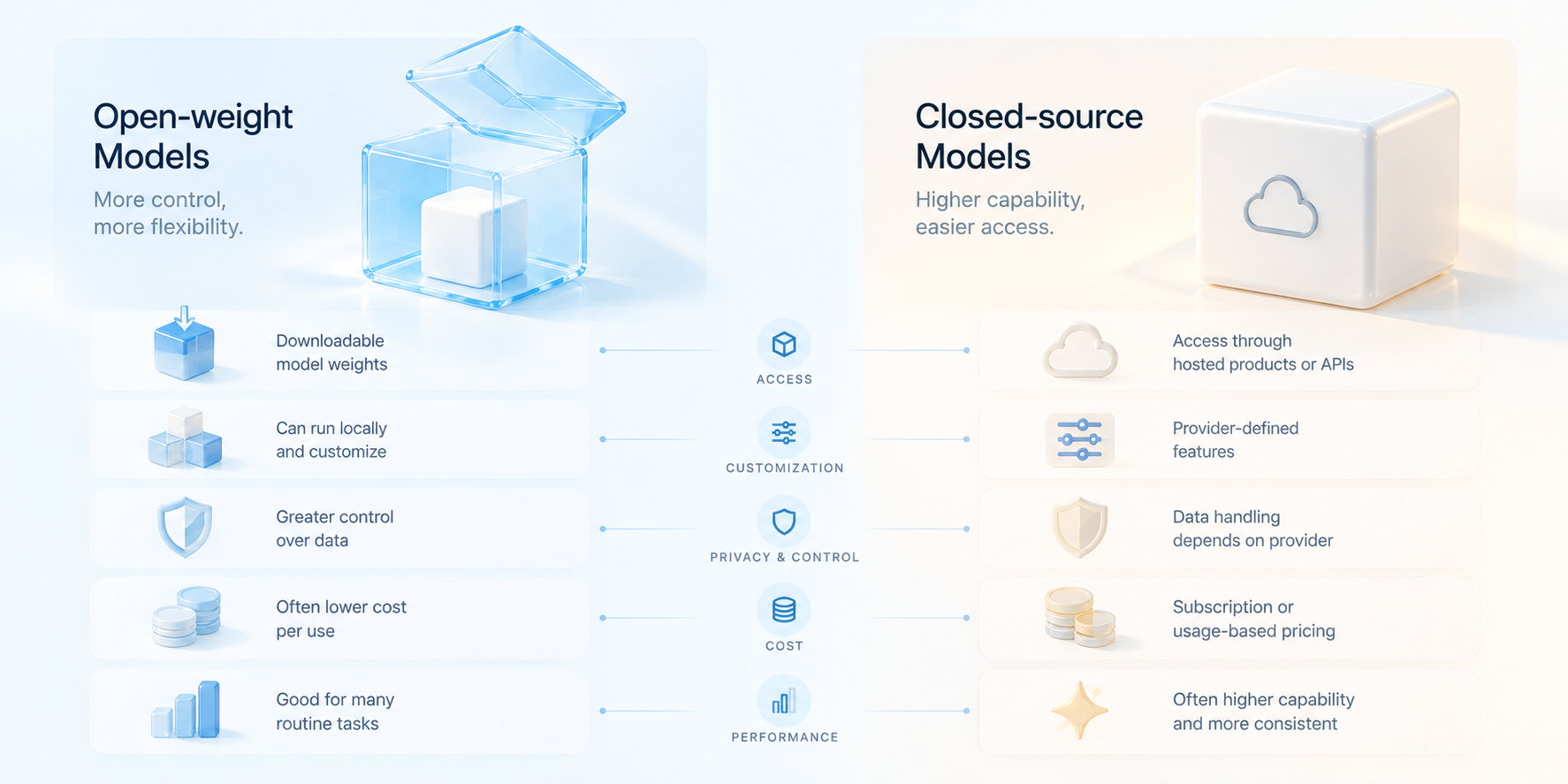
Open-source AI generally refers to systems that make essential components available for people to study, modify, and build upon. However, many models described as open source are more accurately called open-weight models: their weights are available, while their training data or development processes may remain private. Closed-source models, on the other hand, are typically accessed through hosted products or APIs, without direct access to their underlying weights. These differences affect not only how we access AI, but also how much we can customize, deploy, and control it.
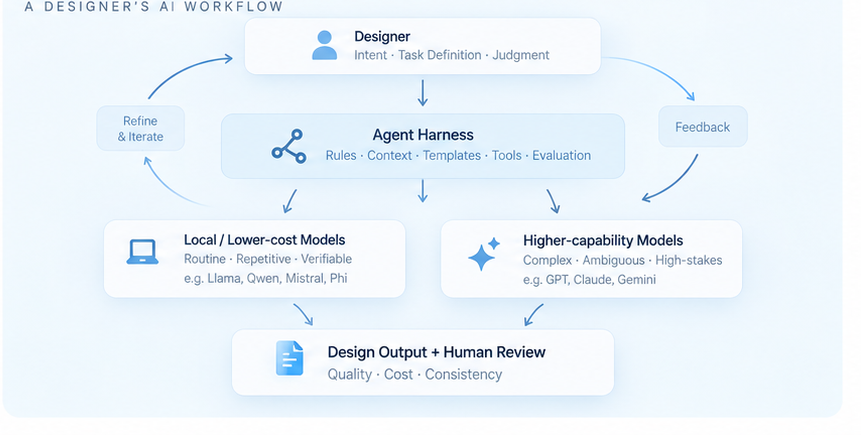
For my own workflow, choosing a model has become a design decision as much as a technical one. A smaller local model might be sufficient for organizing notes, transforming structured content, or handling repetitive tasks, while a more capable hosted model may be worth the cost for complex reasoning, difficult coding problems, or nuanced design exploration. I don't need the most powerful model for every task. I need to understand which capabilities are worth paying for, and which can be achieved with a simpler setup.
03. Designing the Workflow, Not Just the Output
What interests me most is that choosing the model is only the beginning. I can also shape how it works by defining agent roles, behavioral rules, shared context, reusable templates, and collaboration patterns. Instead of relying on a single powerful model to complete an entire task, I can break the process into smaller, more manageable steps and assign different models based on their capabilities. In this sense, I'm not only using AI to create design outputs; I'm designing the system that produces them.
A well-structured agent harness can help smaller or lower-cost models perform more reliably on clearly defined tasks. With appropriate instructions, tools, evaluation, and human review, some work can be completed without constantly calling the most expensive models. Of course, better orchestration cannot eliminate fundamental capability differences, but it can help balance quality, efficiency, and cost. To me, this feels like a natural extension of product design: understanding constraints, defining interactions, organizing systems, and continuously improving how they perform.
04. What I'm Learning as an AI-Era Designer
During an AI-focused design internship, I experimented with local models through Ollama and built a simple dashboard for switching between models and testing prompts. That experience helped me see AI less as a mysterious black box and more as a system whose behavior, limitations, and interactions I could explore. As I've continued working with AI-assisted design and coding tools, I've become more conscious of how I structure tasks, provide context, evaluate results, and decide when a more capable model is actually necessary.
I'm still learning how to balance capability, cost, and control, and I don't believe designers need to become machine learning engineers to make meaningful contributions to AI products. But I do think we need stronger technical literacy, better prototyping skills, and the judgment to decide when and how AI should be involved. Designing with AI isn't just about what I can create with a model. It's also about how I choose, organize, and guide models to work together.